CLIP Goalcast's Top 10 Most Epic Inspirational Speeches | Vol. 1 TaitMedia
Here is Goalcast's collection of top 10 inspirational speeches (Vol. 1)
10 Steps You Need to Learn to Become a Writer

Want to become a writer? Then read this and read this now. Don't tag it as a task or schedule it for later. Read it now.
Big part of being active on the net and social media and also getting your thoughts out there is being able to put pen to paper or "keyboard to screen". You need basic tools, like a computer, tablet or pen and paper, time set aside to write and also the ability to do so.
So let's have a look at the "ability" side of things.
Big part of being active on the net and social media and also getting your thoughts out there is being able to put pen to paper or "keyboard to screen". You need basic tools, like a computer, tablet or pen and paper, time set aside to write and also the ability to do so.
So let's have a look at the "ability" side of things.
Credit: As always we searched the net for the best possible article and we found this one from Location Rebel. Check out their website at https://www.locationrebel.com. Great content on freelancing, blog writing and many more. We will be sharing this to all our clients and patrons so enjoy reading so quality stuff.
____________________________________________________________
Here’s How to Become a Writer (Quick Steps):
- Step 1: Become a better reader
- Step 2: Write Everyday
- Step 3: Start a Blog
- Step 4: Read the book “Everybody Writes” by Ann Handley
- Step 5: Enroll in an Online Writing Course
- Step 6: Find a Place to Get Honest Critiques
- Step 7: Start Journaling
- Step 8: Practice Becoming More Conversational
- Step 9: “Write Drunk, Edit Sober”
- Step 10: Recognize Why You Want to Become a Writer
It’s as simple as that! Of course if you’re actually serious about becoming a writer, then read on for resources and tips to help you with each of these steps.
How to Become a Writer in 10 Easy Steps (Detailed Version)
Below are ten of the things that I’ve done and members of our Location Rebel Academycommunity have done to hone their writing skills.
1) Become a Better Reader
All of the best writers I know are also voracious readers. The more you read, and specifically the more books you read, the more you’re exposed to high-quality writing.
Without realizing this, you are internalizing the elements of the text, and you’ll slowly find yourself beginning to implement them in your own writing.
Not only this, reading gives you ideas. Lots and lots of ideas. And the more ideas you have, the easier it becomes to put them down on paper.
Resources for Becoming a Better Reader:
- Try These Books – Want to get started reading today? Check out this post where you’ll find 12 books to help you jumpstart a love of reading (and prepare you to be a lifestyle entrepreneur).
- Goodreads – This is a social network dedicated to reading. Use it to find books and see reviews, and check out what your friends are reading. You can find quite a few great books on here you might have never thought about before.
- Your Local Library – Yup, libraries are filled with great resources, all for free. And, most libraries now also feature online books and audio resources in addition to all the traditional stuff.
2) Write Everyday
As with anything in life, practice makes perfect.
If you limit your writing to 3 tweets a month, you’re probably not going to improve much.
But if you write every day, you’ll begin to notice the process becoming easier. Thoughts becoming clearer. And most importantly, you’ll begin to enjoy it more.
It’s always more fun to do things we’re good at. Writing is no different.
A great way to do this is by committing to a certain number of words every day.
Chris shoots for 1,000 words a day. As does Srini. Our community manager Liz started with 500 and has seen that habit lead to productivity gains in other aspects of her life as well. LRA member Charles shared how he got a 1,000 word a day practice going here.
And if you’re someone like me whose entire business is built around a blog and the internet? Well the more I write, the more successful I become.
Need a little help writing everyday? These 16 writing tools will get you on the right track.
3) Start a Blog
Speaking of blogs, one of the best ways to become a writer, is quite simply to become a writer!
The fastest way to do this is to start a blog.
Starting a blog completely changed my life. This site began as Location 180 way back in 2009 and has led to living a life I could have never imagined.
The positive effects of starting happened quickly, tool. Just look at these 56 reasons. I was able to write this less than a year after I began this site.
Not sure what to write about? I wasn’t either. Just go back and look at my Archives from the Summer of 2009 – I was clueless, and my writing was pretty rough as well.
But I wrote about whatever I was interested in or thinking about, and over time the niche and topics began to become clearer, the same will happen for you.
Here’s everything you need to get going: The Step by Step Guide to Setting up Your First Blog.
4) Read “Everybody Writes” by Ann Handley
When people ask me for steps on how to become a better writer – I always tell them to readEverybody Writes.
It fully recognizes the concept that we’re always writing, marketing, and promoting – even if we don’t realize it.
It helps you specifically focus on writing engaging and interesting content that will do well online.
Other books I recommend on the topic are:
- Bird by Bird: Some Instructions on Writing and Life by Anne Lamott
- The War of Art by Steven Pressfield
5) Enroll in an Online Writing Course
We just talked about my favorite book for aspiring writers, but what about people that really want to go all in and truly start honing their crafts?
There are a lot of different courses online for people who want to become writers.
My favorite is CopyHour.
This focuses specifically on how to become a better copywriter, or how to be more persuasive with your words. It takes a fair unconventional approach, but works and is how I improved my own skills.
You can find a good list of free online courses to help improve your writing here.
6) Find a Place to Get Real Critiques
This is a problem, not just with writers, but with creatives or business people as a whole.
Often times it can be difficult to get real feedback from people because those closest to you want you to feel good.
They would rather be nice and polite than tell you what you really need to hear.
When you’re trying to improve your writing skills, this is horrible. The last thing you want is to keep repeating bad habits, or spending hours crafting work that isn’t interesting.
Your mom is probably not the best person to critique your work. Neither is your significant other.
Find either a business peer or mentor you trust, or you can find communities online to get real feedback.
Forums for writing critiques:
- Location Rebel Academy – We’re constantly giving our members feedback on their content writing, their websites, and their approach to finding clients. We’re friendly, but firm, and while we’ll always complement the things you’re doing well, we’ll never just tell you what you want to hear.
- Writing Forums – These forums tend to focus on fiction writing, but can be a great place to get feedback on the style of your writing, and to get ideas as well.
- Legend Fire – This is a forum specifically for writing critiques. Again it generally focuses on creative writing but is an excellent starting point.
7) Start Journaling
This is a common thread I’ve seen among many of my most successful entrepreneur friends – they journal.
Sometimes just for 5 minutes a day, some for an hour.
Journaling will not only help you organize your thoughts and prioritize tasks or initiatives but by writing in it on a regular basis, you’re writing will begin to improve.
As we mentioned earlier, the most important thing you can do to become a writer is to write. Journaling can be an easy way to start doing that, without the pressure of having to publicize any of it.
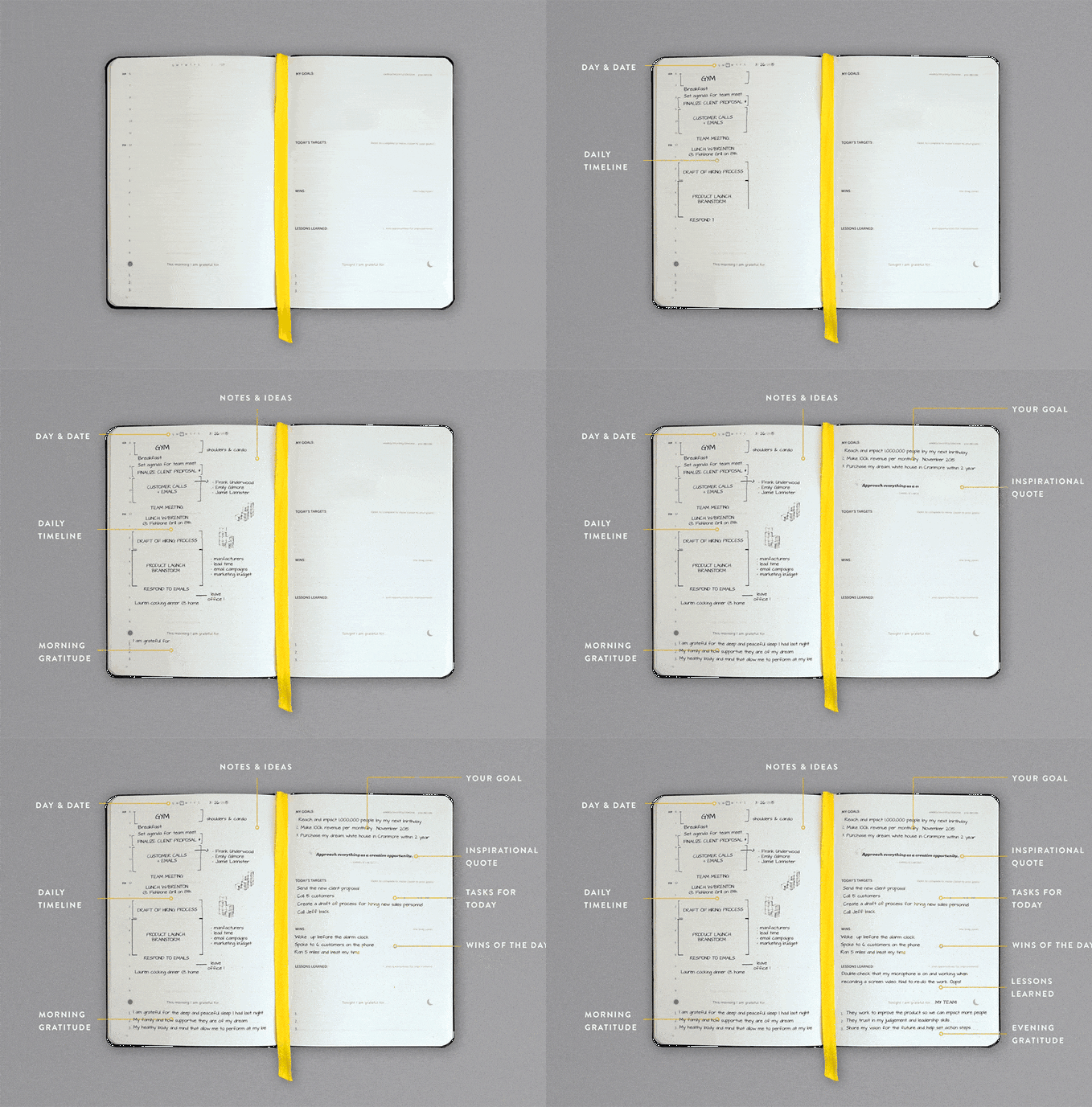
Here are three journals I’ve used:
- Moleskine – This is the best one you can get for writing, hands down. No prompts, just empty pages for you to write out your thoughts.
- Productivity Planner – This was given to me by a friend of mine, and I think it’s great. If the idea of writing in a journal every day is intimidating, start with this. It helps you focus on your daily and weekly tasks. By writing in it daily, you start to build that habit, which you can, in turn, translate into more freeform journal writing.
- Self Journal – Very similar to the Productivity Planner above, but taking a focus on gratitude and tracking small actions every day.
8) Practice Becoming More Conversational
This might be the best piece of writing advice I’ve ever received. One of the first guest posts I’d ever written was for the personal finance site Get Rich Slowly.
The guy behind the site JD Roth, told me numerous times during revisions, “be more conversational and relaxed, use more contractions!”
Online the more conversational you are, the easier your writing is to read, the more relatable and trustworthy you become, and the better your flow of writing becomes.
Comparing my writing in 2009 to now, you’ll notice many more contractions and a very conversational tone.
I have JD to thank for that.
9) “Write Drunk, Edit Sober”
This is the famous quote attributed to Hemmingway, that I think has a lot of validity to it. (Even though most agree Hemmingway didn’t actually coin the term.
Sure you can take it literal if you want, but the way I personally interpret it is let your writing be creative and free-flowing.
Don’t get bogged down in research, adding links, formatting, or overthinking.
Just write.
Then go back with fresh eyes to add edit, revise, format, and to make sure all of the claims you made during your initial draft you know, are actually true.
Hemmingway may not have written drunk, but he sure knew how to pick the good spots inHavana. This was at Hotel Ambos Mundos where he wrote For Whom the Bell Tolls:

10) Recognize Why You Want to Become a Writer
There are a nearly limitless number of good reasons to become a writer. Maybe you want to get into the first stages of freelance writing, maybe you want to up your game and become a B2B content writer, or maybe you want to self-publish lots of books.
But you have to know which of those reasons are the reasons that you want to become a better writer.
As with anything, you can only hone your craft and get better at skills if you have the proper motivation behind it.
So what is your motivation?
Is it to write more compelling Facebook posts to prove to your friends how great your life really is? Is it to get the attention of influencers with your cheeky and cleverly crafted emails?
Or is it more than that?
Whatever the reason is that you’re trying to learn how to become a writer, know the reason, and focus on it during your quest to improve your skills.
______________________________________
CREDIT: As mentioned above we became BIG Location Rebel fans and this article was first published on their website. Check it out at https://www.locationrebel.com. Great content on freelancing, blog writing and many more.
VIDEO The psychology of self-motivation by Scott Geller TEDxVirginiaTech
Scott Geller is Alumni Distinguished Professor at Virginia Tech and Director of the Center for Applied Behavior Systems in the Department of Psychology. He is a Fellow of the American Psychological Association, the Association for Psychological Science, and the World Academy of Productivity and Quality.
He has written numerous articles and books, including When No One's Watching: Living and Leading Self-motivation. Scott will examine how we can become self-motivated in "The Psychology of Self-Motivation."

He has written numerous articles and books, including When No One's Watching: Living and Leading Self-motivation. Scott will examine how we can become self-motivated in "The Psychology of Self-Motivation."
Subscribe to:
Posts (Atom)